Why visit Sarmizegetusa Regia
Why visit Sarmizegetusa Regia
The heart of the Dacian kingdom
Before Rome conquered Dacia, this was its sacred and political centre — moved here by King Burebista and brought to its height under King Decebalus, whose resistance to Trajan's legions is one of ancient Europe's great last stands against Roman expansion. Walking the fortress terraces, you're at the capital of a kingdom that fought Rome to a standstill for years.
A sanctuary unlike any other in Europe
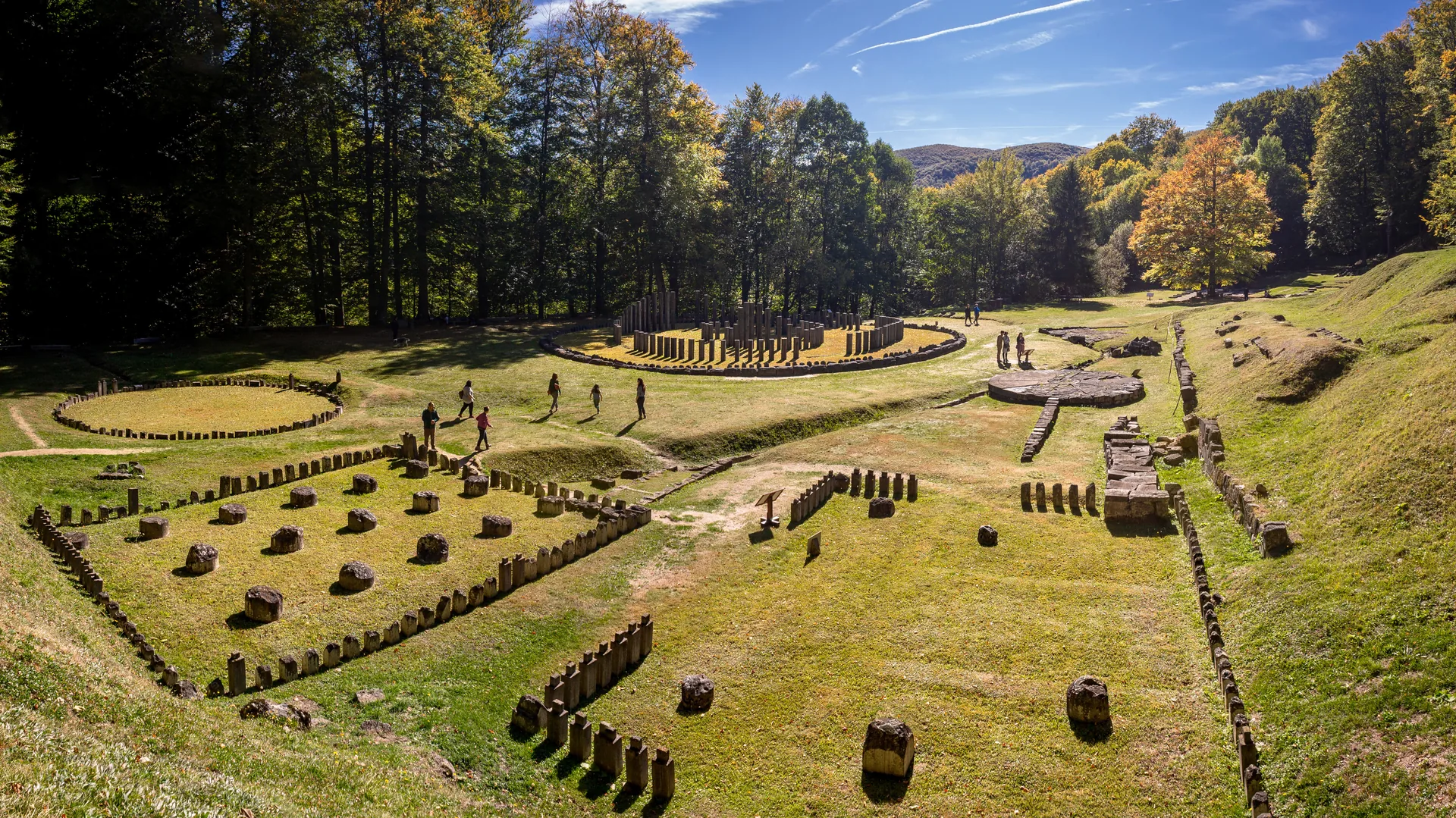
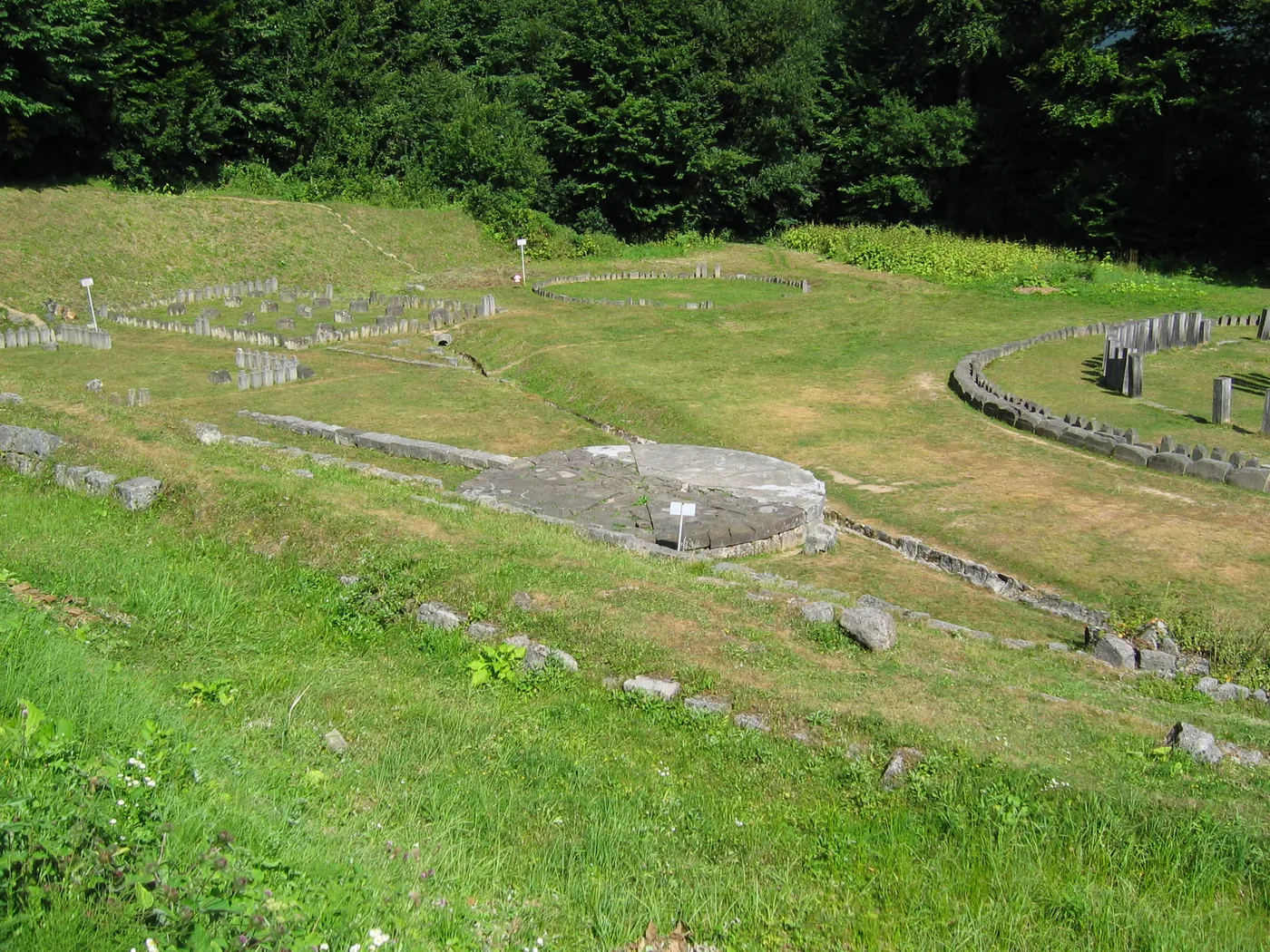
The site's sacred zone holds some of the largest Dacian temples ever found, including a mysterious circular sanctuary of standing andesite pillars — its layout has drawn comparisons to Stonehenge — and the so-called "Andesite Sun," a carved stone disc thought to have worked as a sundial, showing Greek astronomical influence reaching deep into the Carpathians.
Conquered by an empire, protected by the world
Trajan's forces besieged and partially dismantled the fortress in 102 AD, completing the conquest of Dacia by 106 AD — one of the Roman Empire's last great territorial wars. Sarmizegetusa Regia has been a UNESCO World Heritage Site since 1999, recognised as the most complete surviving expression of pre-Roman Dacian civilisation.
What to see at Sarmizegetusa Regia
What to see at Sarmizegetusa Regia
The site sits across a forested mountainside, with the fortress and sacred zone connected by a walking trail. These are the things to look for.
- The fortress
Five stone terraces
A quadrilateral fortress of massive stone blocks, built across five terraces and covering roughly 30,000 square metres — the defensive heart of the Dacian capital.
- The sacred zone
Dacia's largest temples
A cluster of rectangular sanctuaries with visible column bases marks some of the largest religious structures the Dacian civilisation ever built.
- The circular sanctuary
A Dacian calendar
A D-shaped timber-and-stone structure ringed by concentric circles of andesite pillars — an enigmatic monument whose exact purpose (calendar, temple, or both) is still debated.
- The Andesite Sun
An ancient sundial
A carved stone disc, likely used to track time, reflecting Greek astronomical knowledge that had reached the Dacian elite deep in the Carpathian mountains.
- Roman siege traces
Where Rome broke Dacia
Evidence of Trajan's assault remains at the site — the fortress was besieged and partly dismantled in 102 AD, with the conquest of Dacia completed by 106 AD.
- The forest setting
A quiet mountain sanctuary
Set among Carpathian beech forest, the site rewards an unhurried, reflective visit — there are no crowds here, just stone, forest and the weight of a lost kingdom's capital.
Visiting the sacred zone
Visiting the sacred zone
Sarmizegetusa Regia sits deep in the Orăștie Mountains, so it's usually visited as part of a longer Transylvania day or multi-day trip — here's how it works.
A remote mountain site
The site is genuinely off the beaten path, reached via mountain roads into the Orăștie range — which is exactly why it stays so quiet compared to Romania's castle circuit.
Usually combined with Corvin Castle
Most bookable tours pair Sarmizegetusa Regia with Corvin Castle and Alba Iulia, giving a fuller day across Transylvania's medieval and ancient history in one trip from Sibiu or nearby.
What tours include
Private day trips typically bundle transport, a driver-guide, and time at each site; some multi-day Transylvania tours include it as one stop among several. Check exactly what your chosen option includes when you book.
On site
Expect uneven forest paths and some walking between the fortress and the sacred zone — sturdy shoes are essential, and the setting is genuinely remote, so bring water and check conditions before you go.
Sarmizegetusa Regia, in pictures
Sarmizegetusa Regia, in pictures
The sacred zone and circular andesite sanctuary at Sarmizegetusa Regia, in the Carpathian mountains.
Tour options & what's included
Tour options & what's included
| Option | What it includes | Good to know |
|---|---|---|
| Corvin Castle, Sarmizegetusa & Alba Iulia | Private transport, driver-guide, three sites | The main bookable option; genuinely private and flexible |
| Daco-Roman tour with traditional meal | Guide, entrances, a traditional Romanian meal | Good for pairing history with local food |
| Multi-day Transylvania private tour | Sarmizegetusa as one stop among several | Best if you want more of Transylvania in one trip |
| Custom private day trip | Arrange your own route and pace with a driver-guide | Worth asking about given how remote the site is |
Ways to visit Sarmizegetusa Regia
Find a Sarmizegetusa Regia tour for your dates
Every option below is bookable through GetYourGuide, with live availability and the final price shown in your own currency before you pay.
Planning your visit
Planning your visit
Book a private tour
Given how remote the site is, the practical way to visit is a private driver-guide tour — the main bookable option pairs it with Corvin Castle and Alba Iulia for a fuller Transylvania day.
Wear sturdy shoes
The site spans forested, uneven terrain between the fortress terraces and the sacred zone — proper walking shoes make a real difference here.
Allow a full day
Between the drive into the Orăștie Mountains and the site itself, treat this as a full-day excursion rather than a quick stop.
Go with a guide
The layered history — Burebista's capital, Decebalus's resistance, the mysterious circular sanctuary, Trajan's conquest — is genuinely complex, and a guide makes the sacred zone far more meaningful than reading a signboard alone.
Booking flexibility
The listing offers free cancellation, so you can lock in a date for your Transylvania trip and adjust later if your plans change.
Planning a Sarmizegetusa Regia visit
Planning a Sarmizegetusa Regia visit
GEO/FAQ
Sarmizegetusa Regia visit questions
What is Sarmizegetusa Regia?
Sarmizegetusa Regia was the sacred, military, religious and political capital of the Dacian kingdom, in what is now Romania's Orăștie Mountains. King Burebista moved the capital here; it reached its height under King Decebalus (87–106 AD) before Emperor Trajan's forces conquered it, completing the Roman conquest of Dacia in 106 AD. It has been a UNESCO World Heritage Site since 1999.
What is the circular sanctuary?
The sacred zone contains an enigmatic D-shaped structure ringed by concentric circles of standing andesite pillars — sometimes compared to Stonehenge in layout. Its exact function (religious sanctuary, astronomical calendar, or both) is still debated by archaeologists, alongside the carved "Andesite Sun" disc thought to have worked as a sundial.
How do I get there?
Sarmizegetusa Regia is genuinely remote, deep in the Orăștie Mountains in Hunedoara county. Almost all visitors go via a private driver-guide day trip, most commonly combined with Corvin Castle and Alba Iulia from Sibiu or nearby Transylvanian cities.
Is it worth visiting given how remote it is?
If you're interested in pre-Roman European history, yes — it's the single most complete surviving Dacian capital, and its quiet, forested setting is part of the appeal. It rewards travellers with time for a proper Transylvania day trip rather than those looking for a quick stop.
What will I see there?
The highlights are the five-terrace stone fortress, the sacred zone with its large Dacian temples, the circular andesite sanctuary, and the carved Andesite Sun. Evidence of Trajan's 102 AD siege is also visible at the site.
Can I combine it with other sites?
Yes — the main bookable tour combines Sarmizegetusa Regia with Corvin Castle and Alba Iulia, and multi-day Transylvania tours sometimes include it as one stop among several castles and cities.
Still deciding when to visit Sarmizegetusa Regia?
Leave your email and roughly when you're travelling — we'll send a short rundown of how to combine Sarmizegetusa Regia with Corvin Castle and Transylvania.